
2 studies released: Intercity passenger rail Austin to San Antonio is one step closer to reality
June 3, 2026 - TRA Newswire -
Two rail studies between Austin and San Antonio were reviewed by members of the Texas Passenger Rail Advisory Committee in Austin this week.
The committee, put together by Travis County Judge Andy Brown, examined potential alignments on two projects, one underwritten by the Texas Department of Transportation and the other by the Travis County Commissioners Court. Both studies were conducted by HNTB.
The Travis County study focused on using existing highway right‑of‑way and provided a high‑level infrastructure feasibility assessment. The consultant-led high-level feasibility and operational modeling study for passenger rail, between Austin and San Antonio, would use State Toll Road 130 right-of-way and be elevated along Interstate 10 to enter the Alamo city.
The second study, a separate Union Pacific (UP) corridor analysis, would follow the current Union Pacific subdivision between the two cities. That in-depth study also looked at policy and funding implications.
The Austin-San Antonio corridor is one of the most congested routes in Texas and is crying out for more than just more highways to carry people. In the recently released TxDOT Statewide Multimodal Transit Plan, some 266,000 thousand vehicles trek the corridor on a typical weekday. The SMTP noted that "the opportunity for higher capacity, higher speed intercity rail connectivity is most evident within the Texas Triangle."
Initial estimates for new infrastructure to support rail service range from $2 to $14 billion. Current TxDOT plans just to rebuild I-35 between Austin and San Antonio are estimated to top $8 billion. Previously, Texas Department of Transportation (TxDOT) Executive DirectorMarc Williams,in remarks given at a regional transportation summit, stated that the work on the heavily trafficked corridor between Austin and San Antonio "will never conclude" due to perpetual population and economic growth.
While the initial cost of establishing a corridor can be daunting, just rebuilding one major highway interchange with ramps in Texas can run over half a billion dollars. Such was the I-45/I-69 Houston interchange rebuild which was pegged at $501 million.
Attendees debated the project’s policy goals, asking whether the corridor should directly connect central business districts or focus on peripheral airport connections. Stakeholders expressed concern about funding tradeoffs, the relative value compared with highway expansion, and the need to craft a convincing multimodal message for state decision‑makers.
ABIA to downtown San Antonio using SH-130 and I-10
The highway‑corridor study examined alignments using SH‑130 north of Austin and I‑10 into downtown San Antonio, concluding passenger rail is technically feasible inside those highway rights‑of‑way but would require extensive elevated structures. About one-third of the route would be at ground level and two-thirds elevated, with the entire I-10 segment above ground due to tight constraints.
The line would follow SH‑130’s wide median where running in the median is feasible, but when the alignment hits Interstate 10 the corridor becomes congested without a median, so the I‑10 portion is almost entirely on structure to fit within the corridor. The analysis considered passenger rail only and did not examine freight operation within this highway corridor.
The analysis evaluated terminus options including Austin Airport approaches from the east and west and four San Antonio downtown locations, noting many station locations would require elevated structure.
Two operating-speed scenarios were presented. At 125 mph, a trip from the Austin Airport to San Antonio would take about an hour while a 79 mph run would be about 90 minutes. Using federal cost modeling, the project was estimated around $13.5 billion with annual operating and maintenance (O&M) costs between $140-$190 million. The consultant explained the O&M figure was a benchmark derived by comparing similar services (for example, Chicago–Milwaukee) rather than from detailed local operating agreements
No ridership or operations modeling was performed because the scope was limited to infrastructure feasibility. The consultant stated the study assumed one primary operations and maintenance facility, with potential yard track at the other end for staging, but did not analyze exact siting or which city would be optimal
Union Pacific right-of-way downtown Austin to downtown San Antonio
The second study, which analyzed the Union Pacific freight corridor on which the current daily Amtrak Texas Eagle runs, looked at two potential alignments at speeds to 79 miles per hour with a run time of about 95 minutes from city center to city center. Members were shown three scenarios that modeled two, four and eight daily round trips.
The model assumed segregated passenger dispatching where possible but retained freight windows. Adding additional passing track would reduce but not totally eliminate freight‑passenger conflicts in the study.
Capital cost estimates for the UP corridor ranged from $ 800 million to $2.3 billion for two round trips up to $1.8B-$2.0B for eight round trips a day. The report included a new intermediate station at New Braunfels and an operations and maintenance (O&M) facility. Yearly O&M was estimated at $60 million annually based on similar services now running elsewhere.
The operational analysis considered single versus double track tradeoffs and may require some elevated structures.
The study compared UP main one track and main two track which branches north of New Braunfels. Two preferred alignments (A2 and B1A) were selected, and modeled scenarios showed incremental track additions for each service level and additional downtown San Antonio infrastructure required to reach the Amtrak station.
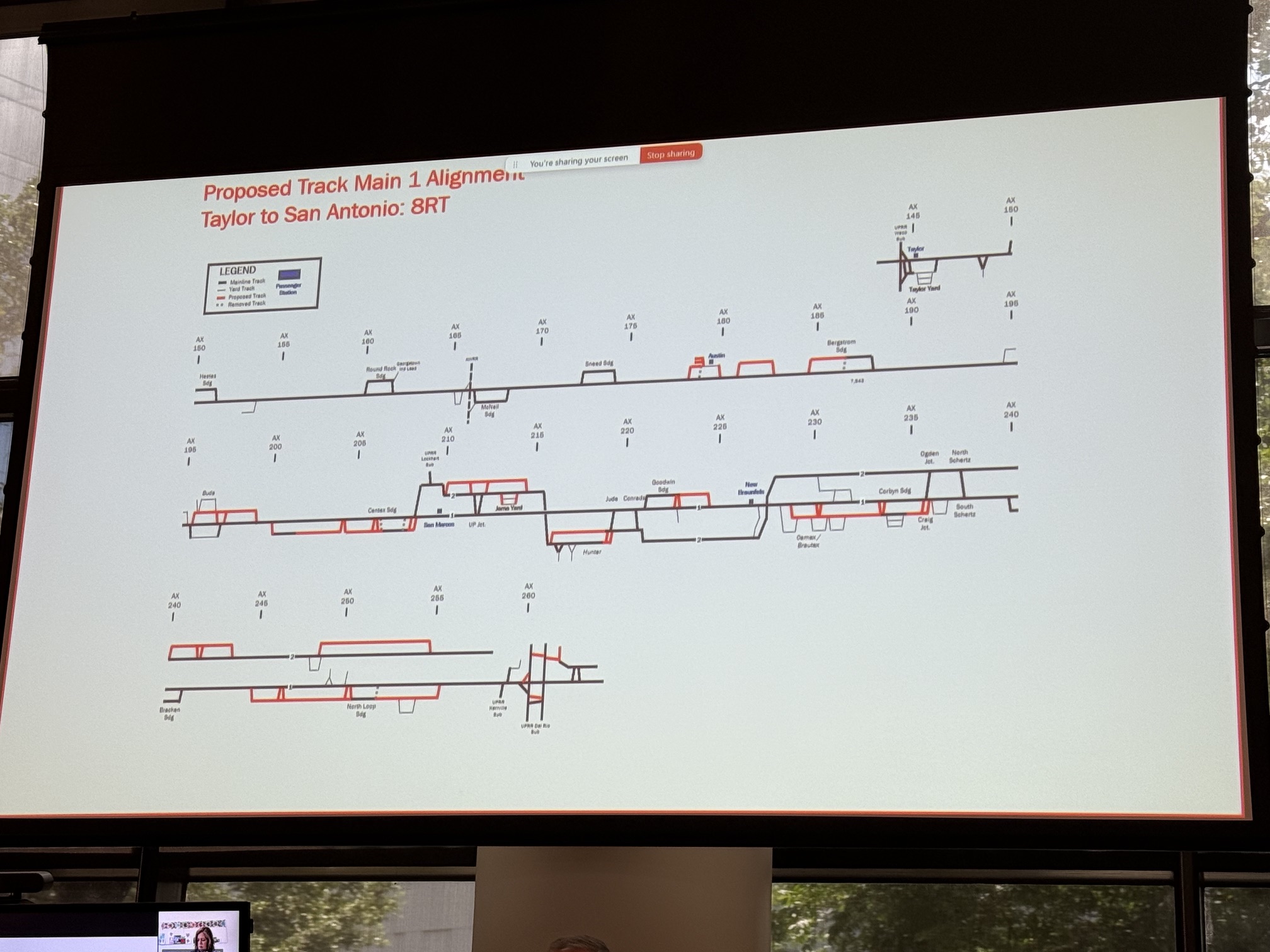
The main sticking point on the UP line was that the company provided limited cooperation. Separating freight and passenger alignments was discussed as a negotiating strategy.
Attendees asked whether the freight right-of-way can accommodate added passenger service; presenters described the corridor as busy, said combining freight and passenger on the same line would be challenging but not overwhelming, and noted the modeling includes a freight growth factor extending to 2045 rather than relying only on current train counts.
The team confirmed cost estimates include improvements to Austin and San Antonio stations and a new New Braunfels station, specifying platform lengthening and storage tracks.
Regardless of either study moving into a project level, discussing revolved around what policies and governance structure could deliver and run the operation, where to locate service facilities, what kind of state or federal funding could be available and the need for backing from the state legislature.
The benefits discussed would be shifting traffic from I-35 to the rail line, relocating hazardous freight away from populated areas and providing fast, frequent intercity passenger rail service to serve an area that will only continue to grow.
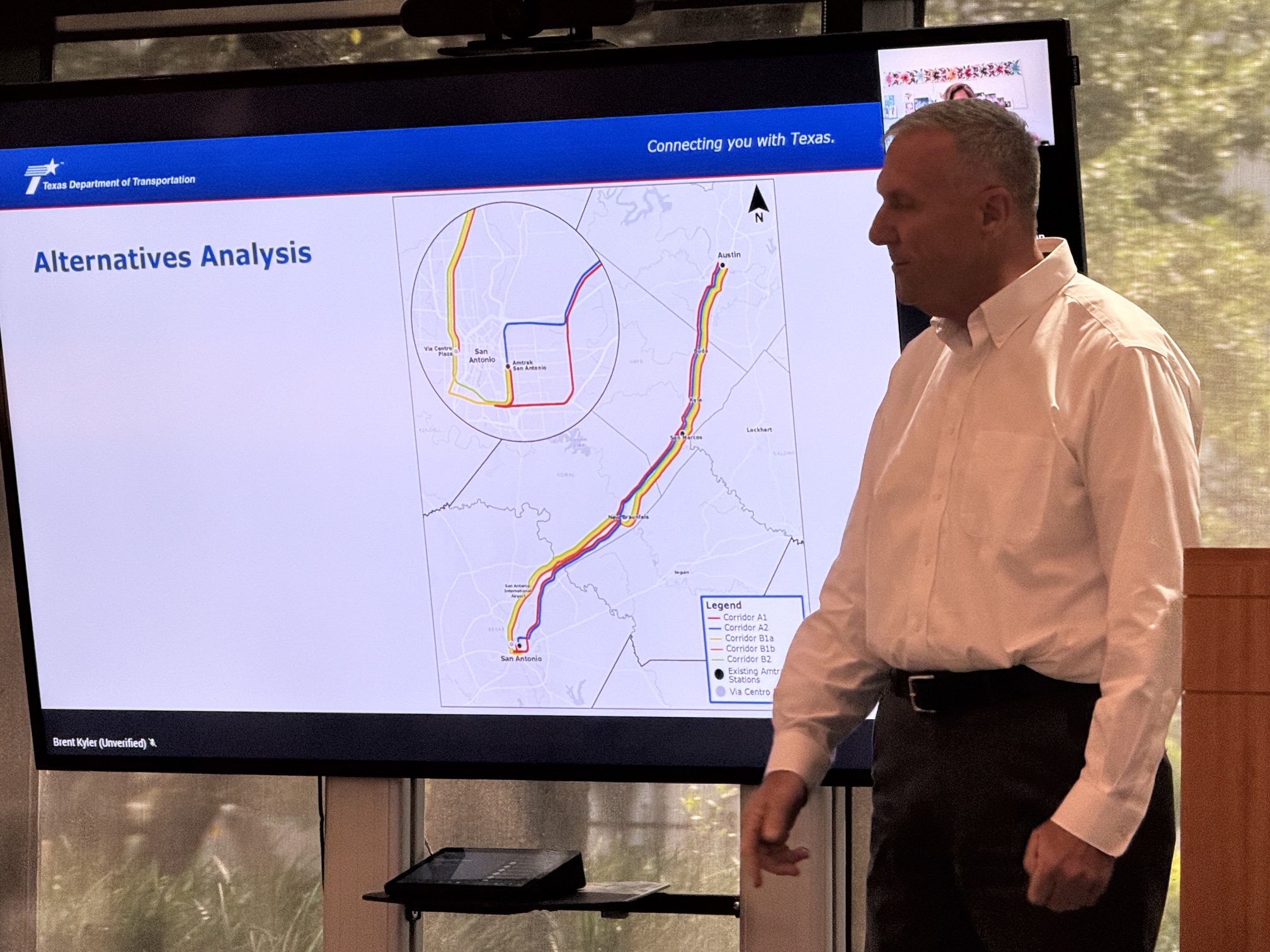
Photo credit: Texas Rail Advocates