
Build America 250 Act: Here's what the proposed Congressional budget for rail looks like
May 21, 2026 - Transportation for America (T4America.org) -
Some good, some not so in the the Building Unrivaled Infrastructure and Long-term Development for America’s 250th (BUILD America 250) Act, which was released by the House Transportation & Infrastructure Committee May 17th.
With not much fanfare or time for advocates and others to do a deep-dive into the extensive document, the bill goes before the committee markup four days later, today, May 21.
Transportation for America supplied their analysis of this year's proposal compared to the IIJA. T4A reports that "this bill is similar to the overall trajectory charted by the Infrastructure Investment and Jobs Act (IIJA) and extends the status quo on federal transportation policy. It fails to orient the program around achieving measurable outcomes."
While the bill does include a modest amount of new funding for the trust fund in the form of a tax on electric vehicles, a significant majority of the cost will once again be borne by all taxpayers via a massive expected general fund transfer into the Highway Trust Fund (and Mass Transit Account) to cover its price tag.
Despite the notable positive provisions, it will fail to deliver a transportation system that safely, affordably, and reliably connects Americans to where they need to go, according to T4A.
Funding overview
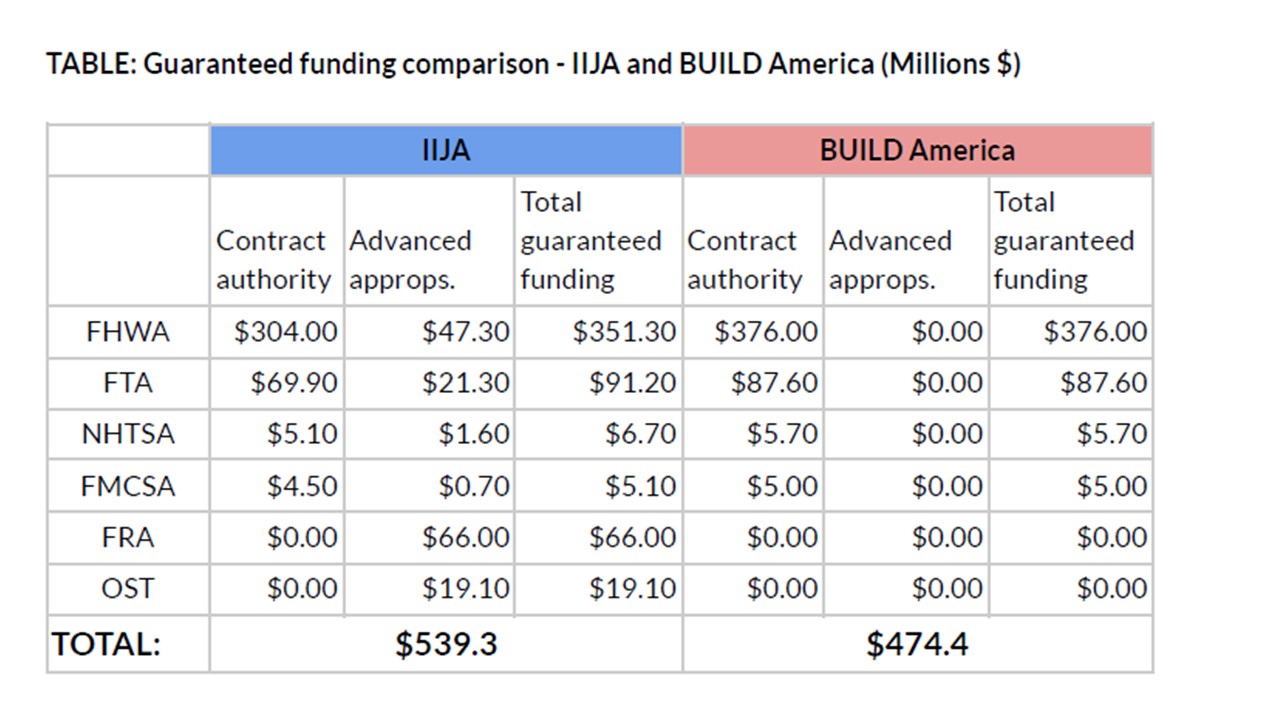
In total, BUILD America’s topline funding of $580 billion reported by the committee includes all authorized amounts, but only $474.4 billion is guaranteed via contract authority. The remaining $113 billion comes from General Fund authorizations that will be subject to the whims of future appropriations decisions and are not guaranteed. (As one example, whereas the IIJA had $66 billion guaranteed for passenger rail, rail gets $0 guaranteed in the BUILD Act.)
In contrast, the IIJA topline guaranteed total funding amount came out to $539.3 billion. Only $383.4 billion was guaranteed by contract authority, but the other $155.9 billion in IIJA was guaranteed by the novel use of advanced appropriations, which ensured the funding in advance without the normal appropriations process. Unlike IIJA, the BUILD America Act does not employ advance appropriations which effectively results in cuts to guaranteed funding across a range of programs compared to the IIJA.
Rail
The BUILD America 250 Act removes all guaranteed funding for passenger rail and reduces even what is authorized for spending on passenger rail, while making marginal improvements around rail permitting and Amtrak accountability. The removal of advanced appropriations for passenger rail will require Congress to do something it didn’t have to do over the last fi ve years and consider whether it will provide rail funding on a yearly basis. With an authorized funding level 38 percent below the IIJA combined with the loss of advanced appropriations, the rail title decreases federal investment in passenger rail and is a step back.
The bill rolls the Federal-State Partnership for Intercity Passenger Rail, Restoration and Enhancement Grants, and Interstate Rail Compact (IRC) grant programs into a new program called the National Intercity Passenger Rail Partnership. This program is authorized to receive $18.5 billion over fi ve years. Non-Amtrak passenger rail operators are added as eligible applicants, which could open the door for more providers for intercity passenger rail to enter the market.
The Consolidated Rail Infrastructure and Safety Improvement Program (CRISI) is authorized to receive $1.72 billion in 2027, increasing year-over-year for a total of $9.1 billion over the five-year bill. This is a decrease from the $10 billion in advanced appropriations under the IIJA. The Railroad Crossing Elimination Program is also reauthorized with a small bump to $675 million for a total of $3.65 billion through 2031, an decrease from $5.5 billion in the IIJA. Amtrak would receive $1.95 billion for the Northeast Corridor in 2027 and a total of $10.3 billion throughout the life of the bill, a decrease from the authorized $12.57 billion in the IIJA. The National Network is authorized to receive $3.9 billion in 2027 with $20.7 billion through 2031, a decrease from the authorized $28.65 billion in the IIJA. It is likely that all the aforementioned programs would receive less than the authorized amounts once appropriators get involved each year.
The bill sunsets the Corridor Identification and Development Program in 2031, halting the development of any further new corridors for future passenger rail service after that year. It also requires more rigorous assessments of revenue, maintenance, and ridership numbers, along with more stringent requirements for verification of non-federal match for the program.
There are several positive policy changes. States are allowed to use a portion of their Surface Transportation Block Grant (STBG) apportionment for planning, design, construction, and improvements associated with a passenger rail station or equipment that serves a state-supported route. The bill also adds accountability measures for Amtrak, including requiring Amtrak to report the numbers and reasoning behind executive bonuses to Congress. The House bill allows states to hire third-parties to evaluate Amtrak’s invoices and pricing for state-supported services, which could decrease the amounts states have to pay for state-supported services.
Additionally, the bill adds language allowing USDOT and Interstate Rail Compacts (such as the Southern Rail Commission or the Gateway Development Commission) to create equipment pools. This would allow IRCs to buy and lease equipment, but it would not fulfi ll our desire to create a national equipment pool. Given that this does not provide funding for equipment purchases or establish an entity to facilitate equipment purchases or maintenance, this will not induce the necessary demand to accelerate equipment purchases in the U.S.. Additionally, because there are only four federally-recognized interstate compacts, any effect from the change is likely to be limited as there are too few IRCs and they would be required to fi nance equipment themselves. It’s a feint in the right direction.
The rail safety subtitle creates several small programs to improve railroad safety, however it lacks larger safety provisions demanded after the East Palestine accident.
The bill creates programs aimed at improving safety, including a Safety Culture grant program and a Rail Technology and Asset Pilot program. The Safety Culture grant program allows nonprofit organizations to conduct safety culture assessments on Class II and III railroads. The Rail Technology and Asset Pilot program creates a discretionary grant program with the goal of improving rail safety & network fluidity and reducing cargo theft. There is a particular emphasis on replacing old cars, implementing positive train control, establishing monitoring systems, and improving technology for crew members.
The bill also establishes programs aimed at improving reporting through the creation of Bridge Inspection Reporting System and a confidential close-call system. The Bridge Inspection Reporting System will allow railroads and governments alike to report when a bridge used for rail seems unsafe. The confidential close-call system allows employees to anonymously report near misses to an independent third party who then creates a report that is sent to the FRA. The FRA then recommends corrective actions to improve safety.
The bill also finalizes a rule allowing freight cars that are more than 50 years old to operate without special approval. It requires Class I railroads to install inward and outward facing cameras in locomotive cabs. It marginally increases penalties for transportation hazardous materials.
The bill makes several changes at the Federal Railway Administration (FRA). It requires the FRA have a minimum number of employees staffed on rail safety. It directs the inspector general to conduct a review of the safety culture at FRA. Finally, it establishes a Rail Safety Advisory Committee at FRA to make recommendations to the Administrator on improving rail safety.
It’s expected that during markup that amendments will be added in order to add additional safety provisions to the rail title.
Repair and maintenance
The BUILD America bill does not make meaningful strides towards prioritizing maintenance and repair on our roadways. States are not required to demonstrate progress towards maintenance goals before they can add new capacity and expand their road system with funds from any of the core federal-aid highway programs. Under the National Highway Performance Program (NHPP), states are required, however, to develop and maintain a state asset management plan. For non-compliant states that do not develop and implement their asset management plan, the federal share for projects and activities with obligated funds under NHPP will be 65 percent. But there are no requirements that the states set or meet progressive repair targets as part of their performance management requirements under section 150 or within the asset management plans themselves.
Transit providers are also required to develop transit asset management plans and, for every year they receive federal funding, establish performance targets for achieving a state of good repair. They must also submit annual reports detailing progress toward those targets and documenting any changes in the condition of the public transportation system since the previous year. Like the highways side, there does not appear to be any requirement that transit agencies set ambitious targets nor any penalty if the transit agency fails to meet their target.
One of the primary highlights of the bill is the consolidation of several former bridge grant programs within a new dedicated apportioned bridge program and a competitive bridge program. Under the formula bridge program, each state receives $75 million and at minimum the amount they were receiving under Division J of the IIJA, and then distributes funding based on the amount of bridge area as well as the amount of bridge area in poor condition. The program also includes a 20 percent set-aside for off-system bridges which states are able to opt out of as well as a 25 percent set-aside for locally-owned bridges, for which states are expected to hold competitive application and selection processes. States are required to submit an annual report describing progress made with completing projects and their effectiveness in reducing the number of bridges in poor condition. These reports would be posted onto a publicly available website. Although modest, this is a step towards improved reporting and transparency about funding and the outcomes they are producing for moving the needle on repair. The competitive, new Bridge Completion program is authorized for $2 billion annually for improving the safety, efficiency, and reliability of bridges on the National Highway System only, but lacks guaranteed contract authority.
Transit
Overall, while the BUILD Act increases guaranteed funding for highways compared to the IIJA, transit was not so fortunate. Though the bill’s authors are quick to note that contract authority for transit is increasing over IIJA levels, the guaranteed amount for transit is actually going down thanks to the loss of advance appropriations. There are a few mechanisms to provide some modest flexibility to use capital dollars for operations, but no substantial new funding for transit capital or operations. On operations funding, the “100 Bus” rule which allows transit agencies that operate fewer than 100 buses to use a portion of funds on operations has been expanded to agencies operating 125 buses. This provides greater flexibility to use formula funds for operations. Additionally, the one percent of urban formula funds that must be spent on transit safety and security increased to 1.5 percent and expanded operational eligibility including police, fare enforcement, addressing fare evasion, hiring transit support specialists and other measures to “reduce criminal activities.” Finally, there is a new State Block Grant program that allows states to roll up transit formula dollars that would come to transit agencies and distribute it out through a competitive program at the state level.
There are a few small changes to the transit capital program, though it’s hard to celebrate even good changes in a program that has been ground to a halt by the current administration. The bipartisan authors in the House have failed to recognize this reality or attempt to hold the administration to following this proposal any more than they do the current law. Some changes include streamlining transit capital project delivery, raising the funding threshold for Small Starts projects (now called Streamlined Starts, increased to a max project size of $1 billion), and broadening the eligibility for Core Capacity projects. Sadly the bill totally eliminates the dedicated funding for low- and no-emission bus procurement.
Overall, although the text expands some operations funding, it is only in the context of allowing transit agencies to choose whether to use each dollar for operations or capital, rather than a new dedicated operations funding stream. Increasing transit operations funding is vital to providing robust, reliable and frequent transit. According to T4America's World-Class American Transit report, to run the new vehicle fleet acquired under the world-class transit scenario, we would need to invest $989 billion in transit operations above projected baseline levels between 2026 and 2045, or $2.48 trillion, including baseline spending. Expanded transit operations flexibility is peanuts in contrast to what solutions are actually needed to provide reliable and frequent transit services.
Regional/local funding and MPOs
Other than the drastic reduction in competitive grant funding (covered in a separate section at the end of the report) which are typically heavily tapped by local communities and regional planning entities, the other changes to local funding will be most interesting to metropolitan planning organizations (MPOs). For MPOs, the BUILD Act directly sub-allocates contract authority and requires sub-allocation of obligation limitations. These sub-allocated funds would also be available for a two-year period instead of the standard one-year period. The bill further allows MPOs to qualify as direct recipients for metropolitan planning (PL) funds, subject to a new process created by the Secretary. The federal share payable for projects carried out with PL funds is 90 percent, which would be favorable for locals and MPOs.
Competitive and discretionary grants for local communities
While competitive grant programs make more funding available directly to local communities, T4America was amongst the chorus of voices suggesting that the IIJA went overboard in creating a long list of new discretionary grant programs, accounting for somewhere around $200 billion of the total cost of the IIJA. Setting up new grant programs is complex and time-consuming, and it was a significant challenge for the Biden team at USDOT to get them all moving on time. In some cases, grant agreements that should have already been signed when President Trump took office were still in the works and subsequently rescinded. Another theme with the IIJA’s new grant programs was a heavy focus on climate mitigation and adaptation.
The BUILD Act definitely pushes the needle back toward both maximizing formula funding at the expense of discretionary grants, and it kills or consolidates every single one of the climate-focused grant programs, like NEVI, Charging and Refueling Infrastructure, the Carbon Reduction Program, the Congestion Relief Program, Reduction of Truck Emissions at Port Facilities, the Healthy Streets Program, and the Active Transportation Infrastructure Investment Program (ATIIP), just to name a few. Overall, discretionary grants represent a much smaller share of the bill’s total price tag vs. the IIJA’s set of supercharged grant programs.
As noted in the safety section, the Safe Streets for All grant program did survive and was codifi ed into the highway title and given guaranteed contract authority, though with half as much money. ($3.75 billion over fi ve years)
The most signifi cant other change in grants that local communities frequently access is the end of the BUILD program. (The one that started as TIGER, became BUILD in Trump’s fi rst term, RAISE under Biden, and was changed back to BUILD in 2025 again.) This popular program for locally focused projects was technically consolidated into a new program called the Surface Transportation Accelerator Grant program (STAG), which was aptly described by Rebecca Higgins at the Eno Foundation as “the one discretionary grant program to rule them all.” This $2.4 billion annual multimodal grant program technically has three separate sections in it, with money set aside for 1) rural grants, 2) urban grants, and 3) grants for regional or local projects. Just like the program it replaces, the eligibilities for project types and who can apply are very broad. The rural grants are unfortunately only for highway and bridge projects, but the other two are broad and multimodal. As with BUILD, the current administration will seek to put their stamp on the projects selected and advance their particular priorities.