
Deep dive: TxDOT study finds more frequent Austin-San Antonio rail feasible on existing corridor
July 15, 2026 - TRA Austin - Jakob W. Schmidt, Austin community liaison for Texas Rail Advocates, and TRA contributor Kal Silverberg -
The Texas Department of Transportation has released its Austin-San Antonio Passenger Rail Study, a June 2026 report from consultant HNTB that examines what it would take to run more frequent passenger trains between the two cities along the existing Union Pacific Railroad (UPRR) Austin Subdivision, the corridor the Amtrak Texas Eagle uses today.
The study stops short of recommending a specific option or advocating for the service. It identifies the infrastructure that would be needed, estimates capital and operating costs, and models potential ridership.
A separate study, funded by the Travis County Commissioners Court, utilizes a route from Austin's airport, along the state highway 130 corridor and I-10 into downtown San Antonio. That study is expected to be fully released in the near future.
The current service
The Texas Eagle makes one round trip per day between Austin and San Antonio, with a stop in San Marcos. The single daily trip is poorly aligned with commuter or day-trip demand, and it runs late often. Amtrak's 2024 host railroad report card puts the Texas Eagle at 56% on-time performance below the 80% federal standard.
Rail is also slower than driving on much of the route, most sharply southbound between San Marcos and San Antonio, where the train presently averages 19 mph against roughly 50-plus mph by car, because of a circuitous route.
Service options modeling
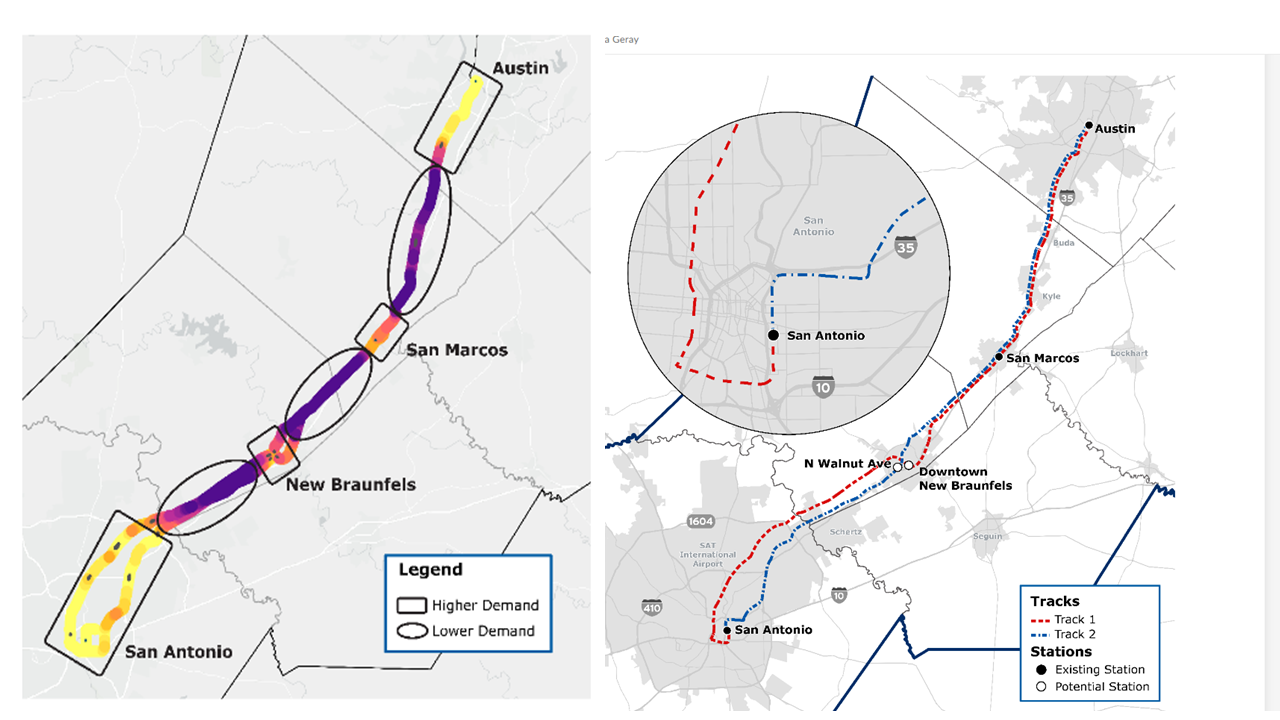
The study advanced two routings, one on Austin Subdivision Main 1 and one on Main 2, and modeled each at two, four, and eight round trips per day over a 16-hour service span. Trains would run at the same 79 mph maximum as today. With targeted track-speed upgrades, the pure running time would be about 95 minutes. Adding station dwells and schedule recovery time brings the total scheduled trip to just under two hours, still a 27-minute improvement northbound and 46 minutes southbound over the current Texas Eagle. A new station in New Braunfels is proposed in all scenarios, with two candidate sites under review.
The study concluded the added passenger service could be absorbed without degrading freight, provided supporting infrastructure gets built. At eight round trips, that means both tracks becoming fully bi-directional. Two of the required projects carry significant right-of-way and grade-separation impacts, a new siding in Austin within the MoPac median and a third main track through San Antonio.
Every scenario also requires a new operations and maintenance facility to store and service the trains, since the nearest Amtrak facility is in Fort Worth; the study assumes a site near New Braunfels, roughly midway between the two cities.
Costs
Capital costs scale with frequency and routing, from $810 million for two round trips on Main 1 to $1.89 billion for eight. The Main 2 routing runs higher at the low end because it lacks existing sidings.
Annual operations and maintenance for the eight-round-trip scenario is estimated at about $61.1 million on Main 1 and $59.2 million on Main 2 in 2045.
Market and ridership
The market analysis found a strong underlying travel base. The study counts roughly 55,000 to 58,000 weekday trips between the station areas, defined as the ZIP codes within about five miles of each existing and proposed stop. The range depends on which New Braunfels site is chosen. The report calls that figure conservative, since it captures only trips between the specific places a train would serve, not metro-to-metro movement overall.
Within that base, the trips rail competes for most effectively are the longer ones. Of the long-distance trips on I-35, 88% take longer than 40 minutes. Traffic delay on I-35 runs about $16,000 a year in lost time and wasted fuel for every lane-mile on the approaches into Austin and San Antonio, no direct commercial flights connect the two, and population and job densities near the stations are projected to roughly double by 2050.
The ridership estimates are the least settled part of the report. A custom spreadsheet model, calibrated against Amtrak's comparable Hiawatha line in the Chicago-Milwaukee corridor, put the expected scenario at about 2,337 riders per day. TxDOT's Statewide Analysis Model produced just 451 and never exceeded 1,000 even under generous assumptions. The report flags the model's inelastic response as unexpected and calls it a potentially unrealistic estimator for this corridor, leaving a wide range rather than a firm forecast.
Independent Analysis
We asked for a third-party view of the study and Kal Silverberg, Lead Consultant at One Track Mind Consulting, LLC, responded with these initial observations:
- The study lacks an executive summary that details the bottom line: X trains at X capital yields X riders for the three different frequency scenarios (2 round trips, 4 round trips and 8 round trips).
- "I don't buy the demand study. It states upfront that it underestimates the spreadsheet tests and the comparison to the Hiawatha service (Chicago to Milwaukee). My thought is the formula calculates demand for one round trip; the second round trip more than doubles demand (i.e. people have two choices to leave and two to return); and it keeps increasing exponentially,"continually raising ridership, according to Silverberg.
- Silverberg said he found it interesting in the capital cost comparison that two round trips take over half of the total capital costs of a projected eight round trips. "Just build it for eight trips to save on the total eventual costs."
- Silverberg, a former BNSF Railway planner, was concerned about the lack of adding double-tracking between San Marcos and Austin; a missed opportunity for a San Antonio station stop on the North Loop and that CapMetro wasn't part of the Austin discussion with an opportunity to extend service north to Cedar Park with a future connection to the current Red Line service at McNeil in northeast Austin. He also pointed out that longer freight trains nowadays will require sidings of at least 15,000 feet to allow passenger trains to pass without stopping, and that is much longer than the siding length proposed in the study.
- The consultant said that while the initial cost of construction and operation may see high to the average person, compare it with the billions of dollars that will be spent over the next two decades on upgrading Interstate 35 between Austin and San Antonio, and how induced demand will negate any real long-term benefit.
Union Pacific did not participate
Union Pacific, which owns and dispatches the corridor, did not take part in the study. The railroad provided no track charts, signal data, freight volumes, timetables, or operating practices. HNTB built the analysis entirely from public sources: FRA grade crossing inventory, Amtrak schedules, Lone Star Rail District documents, and aerial imagery. The project list and costs could shift if Union Pacific eventually provides real operating data.
The railroad's absence is not new. Union Pacific ended an earlier agreement with the Lone Star Rail District, a prior effort to bring commuter rail to the corridor, in 2016 over concerns about relocating its freight operations.
What’s next
The study is a planning document. More detailed ridership and revenue modeling, environmental review, and engineering would need to follow. The report is also explicit that
TxDOT would assist with planning while another entity would have to fund and operate any service, and that construction money would have to come from elsewhere.