Tale of two routes: More revealed about passenger rail study connections between Austin and San Antonio
August 22, 2026 - TRA Newswire -
We're learning more details about a second study for future passenger rail between Austin and San Antonio that could run trains primarily above-ground at speeds up to 125 miles per hour.
It's one of two routes in discussion to help alleviate growing traffic woes between two of Texas' largest cities.
On June 3rd Texas Rail Advocates was first to bring you early news of the two studies, one initiated by the Texas Department of Transportation and the other from Travis County Commissioners. Engineering firm HNTB conducted both studies and revealed preliminary information in the Austin briefing that Texas Rail Advocates attended.
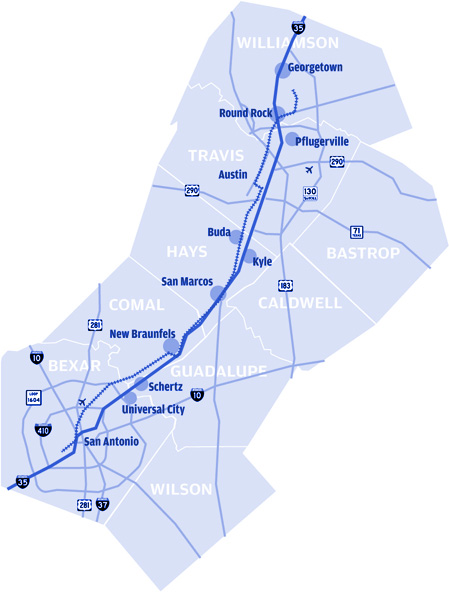
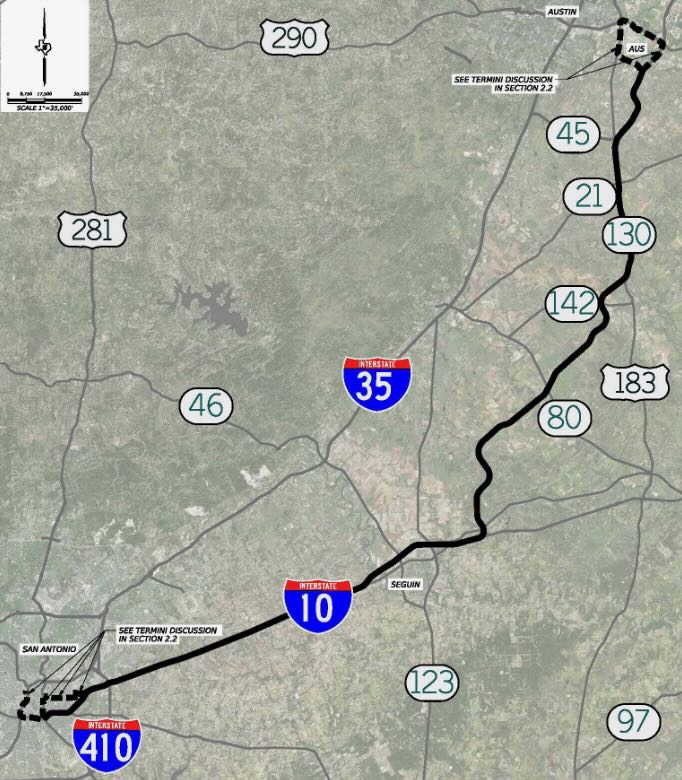
One study would require working with Union Pacific Railroad (UPR) on existing right-of-way between Austin and San Antonio and the other would utilize right-of-way using State Highway 130 toll road and Interstate 10.
A tale of two very different routes and varying costs
This week Travis County Judge Andy Brown released additional information on the high-level feasibility analysis on the SH130 toll road/I-10 interstate corridor. The study was not as in-depth as the TxDOT/Union Pacific study on the existing rail corridor. The UPR study included infrastructure costs, adding a second track, potential ridership and diagramed up to 8 round trips a day between Austin and San Antonio.
The SH130/I-10 study estimates the project would cost about $13.5 billion to build. HNTB estimated that over half of the 90-mile route would need to be elevated, a much higher cost than running trains at ground level. The Travis County study would connect to Austin-Bergstrom International Airport. The $13.5 billion estimate includes construction, design, trains and a 45% contingency for possible cost increases.
That breaks down to an average of some $69 million a mile, still below the $87 million per mile for estimated Interstate 35 construction costs.
Trains would run up to 125 miles per hour allowing for about a one-hour travel time between the cities, without intermediate stops. The passenger rail service would operate separately from freight trains but would bypass intermediate population centers like San Marcos and New Braunfels.
The Travis County study costs would include six train sets, each with two locomotives and three coach cars for a total of $360 million and a $300 million operations and maintenance center. Annual operating costs are forecast between $140 to $190 million.
The Union Pacific route study depends on how much additional track and infrastructure would be needed on Union Pacific property. Capital costs scale with frequency and routing, from $810 million for two round trips to $1.89 billion for eight round trips. With targeted track-speed upgrades, the pure running time would be about 95 minutes. Annual operating costs are pegged around $60 million.
The Union Pacific hurdle
One major hurdle to overcome would be cooperation from the freight railroad, Union Pacific. The railroad did not participate in the HNTB study so assumptions had to be made relying on federal railroad data and other input.
Union Pacific hosts the only daily passenger train between the two cities. Amtrak's Texas Eagle runs from San Antonio through Austin and Dallas-Fort Worth to Chicago. The northbound train leave San Antonio in the morning and the return from Austin is in the evening. The on-time performance of the Texas Eagle hovers slightly above 50%. Union Pacific says it presently doesn't have capacity for any more passenger trains.
"Past efforts have found the existing freight corridor is not sufficient to accommodate both freight and passenger demand," Union Pacific spokesperson Robynn Tysver told KUT News on Thursday. "We believe that is still the case today and we are focused on serving our customers and taking trucks off the state's congested highways."
Union Pacific does accommodate passenger rail operations in other parts of the western U.S. but only after extensive publicly funded infrastructure upgrades were completed to protect current and future freight rail customers and operations.
An example is the Capitol Corridor between Sacramento and the Bay Area. Established in 1991, Capitol Corridor is an Amtrak-operated intercity passenger train route in Northern California, connecting San Jose to Auburn. Managed by the Capitol Corridor Joint Powers Authority (CCJPA), a partnership of six local transit agencies, it is the only locally managed Amtrak service nationally. The route, which connects major Northern California cities, ranks as Amtrak's third busiest nationally. Known for amenities including Wi-Fi and a Café Car, it achieved 95% on-time performance in 2011
Judge Brown says we have to move forward
In an interview with KUT news, Travis County Judge Andy Brown said the region's continued growth makes passenger rail increasingly important. “Today, we've got about 5 million people here in the sort of, Travis County-Bexar County mega region. We're supposed to have about 8 million by 2050,” Brown said. “And just having one highway, no matter how great it is, in between those two areas isn't enough.”
Brown said passenger rail has been discussed for decades, but he believes the region needs to move forward before construction becomes even more expensive and land becomes harder to acquire. “Had we done it then, we would all be riding trains and talking about expanding them today. But we didn't,” Brown said. “And so, the cost now is much higher than it was 20, 30 years ago.” He points to interest from TxDOT in passenger rail, support from county judges and conversations with state lawmakers and Senator Ted Cruz.
Judge Brown said that federal funding would be sought to help defray initial construction costs and there are government entities like the Central Texas Regional Mobility Authority could potentially help operate the system and cover ongoing costs.
Travis County's next step would be a study to look at the economic impact a rail line would bring, potential ridership and how it could tie in with existing transportation systems. Costs could be shared with the counties that the rail line would serve.
Once a plan can be solidified and funding secured, the judge estimates construction could take up to four years.
See also:
https://www.kvue.com/article/news/community/transportation/new-study-explores-passenger-rail-connection-austin-san-antonio-texas/269-2a054018-e576-434e-9a73-514ef6650eab
The Union Pacific right-of-way study runs West of Interstate 35. the SH-130 and I-10 study runs East of Interstate 35